Rodrigo Beckmann
CEO
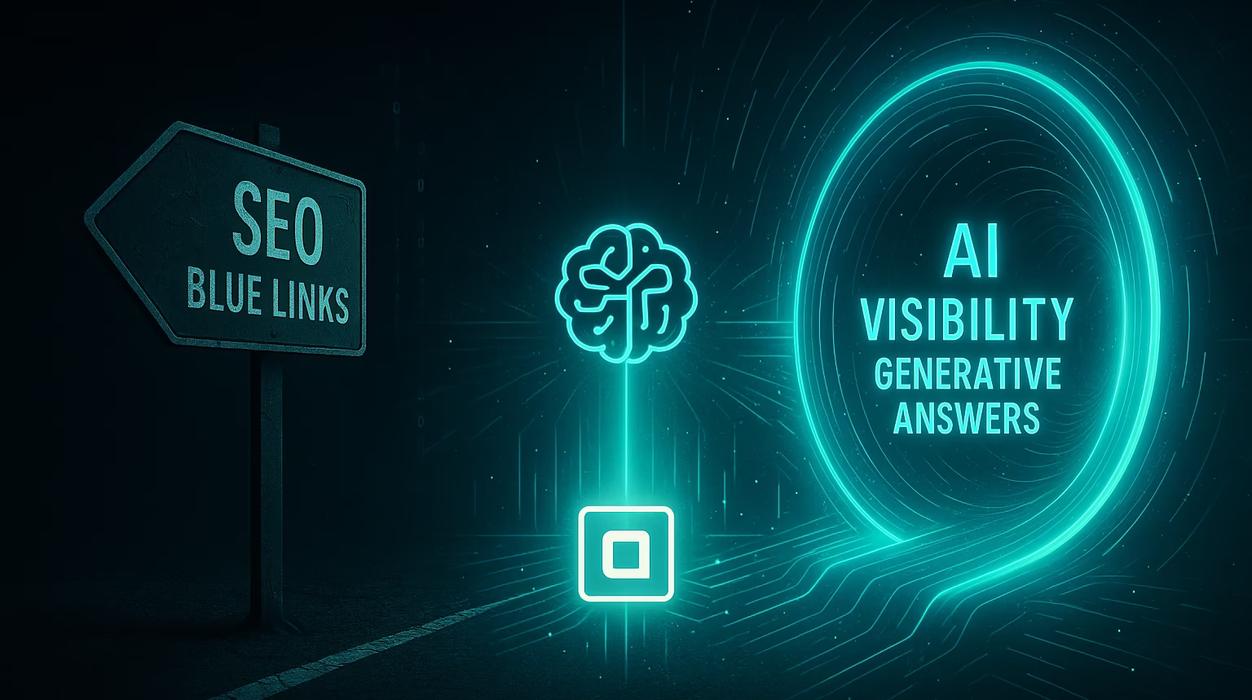
The era of digital search is undergoing its most radical transformation since the invention of search engines. For years, the goal was clear: reach the top of the list of blue links. Today, the battlefield has changed. Purchasing decisions, opinion formation, and brand discovery are happening in a new space: answers generated by artificial intelligence.
If your brand is not present in the conversations of ChatGPT, Gemini, and Copilot, it risks becoming invisible. Welcome to the era of AI brand visibility.
This new landscape requires more than traditional SEO. It demands a new mindset and a new set of strategies focused on being the answer, not just a link to it. It’s about ensuring that when a consumer asks an AI for the best solution to their problem, your brand is mentioned, recommended, and validated as a trusted source. For marketing professionals, growth hackers, and brand managers, understanding and mastering AI Brand visibility is no longer an option, but a strategic necessity for survival and growth.
In this complete guide, we will explore what AI brand visibility is, why it redefines digital marketing, and how your company can start measuring, optimizing, and leading in this new paradigm with the help of innovative platforms like First Answer.
What Is AI Brand Visibility and Why Is It the New SEO?
AI brand visibility is the capacity of a brand, product, or service to be found, mentioned, and prominently recommended in responses generated by Large Language Models (LLMs) and answer engines. Unlike traditional SEO, which focuses on ranking pages in a list of results, AI brand visibility focuses on influencing the AI’s knowledge base so that it cites your brand as an authoritative solution.
Think of it as the evolution of digital reputation. Before, authority was measured by backlinks and ranking positions. Now, it is measured by the frequency and context in which your brand appears in AI responses. This matters for three fundamental reasons:
- The Starting Point Has Changed: Increasingly, the consumer journey does not start on Google, but in a conversation with an AI. Questions like “what is the best CRM software for small businesses?” or “compare the iPhone 16 with the Samsung S26” are being answered directly, without the need for a click.
- Implicit Trust: AI responses are perceived as a curated and trustworthy summary of the web. A positive mention in this context carries significant weight, acting as powerful social proof.
- Traffic and Conversions at Risk: Ignoring AI brand visibility means risking a growing portion of your traffic. Studies already indicate that Google’s AI Overviews result in a drop in click-through rates for organic and paid results, directly impacting conversions.
In summary, AI brand visibility is not just about being seen; it’s about being validated as a source of truth in the most influential information ecosystem of the next decade.
The Inevitable Transition: From SEO to GEO and AEO
Digital marketing is defined by acronyms, and two new ones are rapidly becoming essential: GEO (Generative Engine Optimization) and AEO (Answer Engine Optimization). They represent the natural evolution of SEO for the new context of AI..
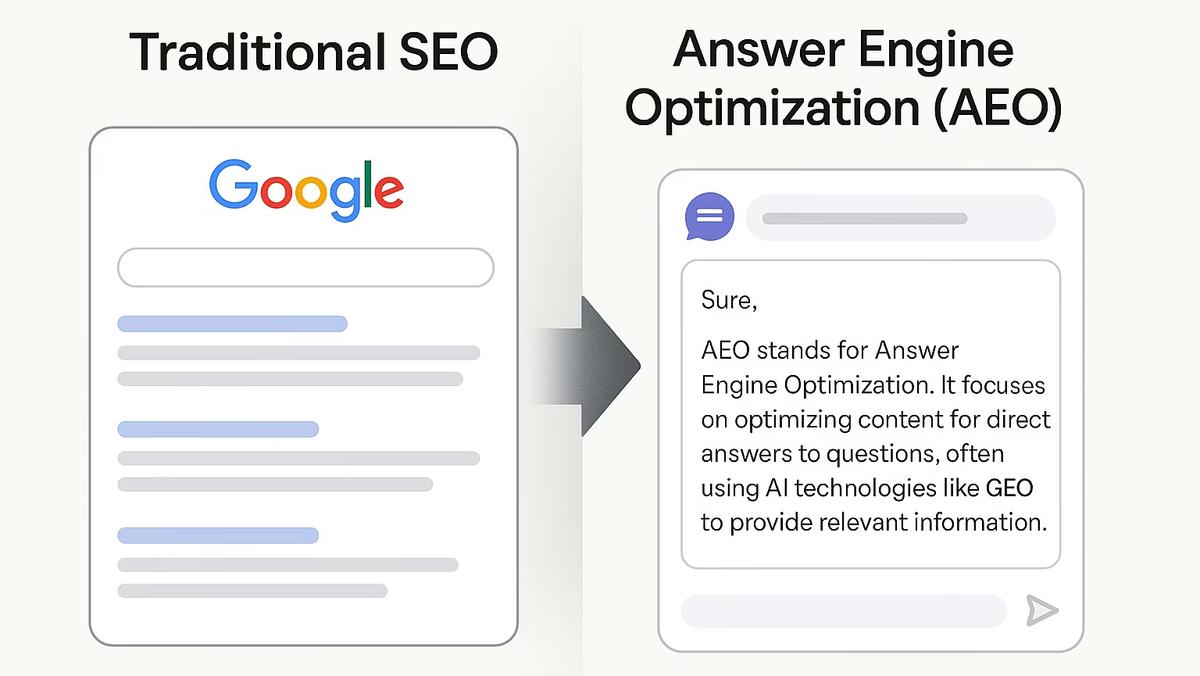
- SEO (Search Engine Optimization): Focused on optimizing pages and sites to be ranked by algorithms that value technical signals, content, and backlinks, aiming for clicks.
- AEO (Answer Engine Optimization): Focused on optimizing information and data to be easily understood and utilized by answer engines (like Google Search with AI). The goal is to appear directly in the answer.
- GEO (Generative Engine Optimization): A broader concept, focused on optimizing the brand’s presence and reputation across the entire digital ecosystem to influence the responses of generative AI models like ChatGPT and Gemini.
While traditional SEO optimizes pages for clicks, GEO and AEO optimize brands for answers—where decisions are already being made.
This transition is fundamental. What changes in traditional SEO with the arrival of answer engines is not just the tactic, but the objective. The goal is no longer just to drive the user to a page, but to ensure that the correct information about your brand is the foundation of the answer they receive. The difference between GEO and AEO lies in scope, but both share a principle: optimization is now for the machine that generates the response, not just for the algorithm that ranks links.
How to Measure and Monitor Your Brand’s Presence in AI Models
You cannot optimize what you cannot measure. The first step to improving your AI brand visibility is establishing a baseline. AI brand monitoring is the continuous process of tracking how and where your brand is mentioned, how it compares to competitors, and which information sources are shaping your digital reputation in the eyes of the AI.
Traditional SEO metrics (ranking, organic traffic, CTR) are insufficient here. The new metrics to observe include:
- Mention Frequency: How many times is your brand cited in answers to prompts relevant to your sector?
- Sentiment Analysis: Are the mentions positive, negative, or neutral?
- Citation Context: Is your brand presented as a leader, an alternative, or just one option among many?
- Share of Voice (SOV) in AI: What is your share of mentions compared to your direct competitors?
- Influence Sources: Which articles, forums (like Reddit), reviews, and news are being used by the AI to formulate answers about your market?
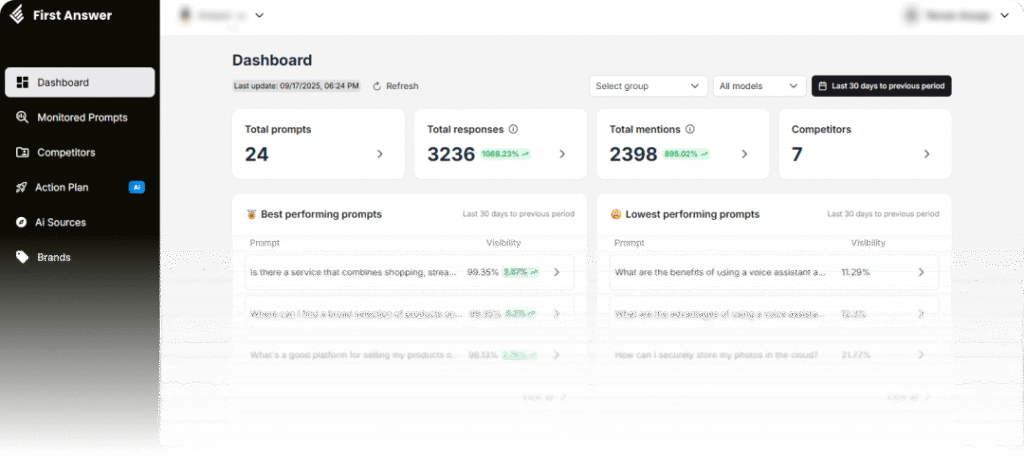
Performing this monitoring manually is impractical. This is where specialized platforms come in, such as First Answer, which automate this process and provide clear dashboards to track your performance.
Tools and Techniques to Improve Your AI Brand Visibility
Once you understand your current position, it is time to act. Improving digital brand visibility in the context of AI involves a multifaceted approach that combines content, technical SEO, and digital public relations.
Here are some practical strategies:
- Optimize for Entities and Topics: AIs think in terms of entities and their relationships. Structure your content around topic clusters, responding directly to what Search Engine Land calls FLUQs (Follow-up Language Understanding Questions)—the “hidden questions” users would ask next to deepen a topic.
- Build Authority in Trusted Sources: AIs rely on sources they consider authoritative. This includes not only major media outlets but also review sites (like Capterra and G2), niche forums (Reddit, Quora), and specialized publications.
- Use Structured Data (Schema Markup): Implement Schema to help AIs understand the context of your content unequivocally. Markups like Organization, Product, and FAQPage are essential.
- Create Comparative and “Best X for Y” Content: A large part of AI queries involves comparisons. Create detailed and impartial content that compares your solution with competitors, positioning yourself as the best choice for specific segments.
- Monitor and Fill “Citation Gaps”: Identify high-authority articles and lists that mention your competitors but not your brand. Reach out and present a compelling argument for your inclusion.
- Use LLM Monitoring Tools: To scale these efforts, it is crucial to use dedicated tools. Platforms like First Answer are essential for monitoring LLMs and understanding your visibility.
The Real Impact: How ChatGPT, Gemini, and Copilot Are Shaping Consumer Opinion
The use of ChatGPT and Gemini in marketing goes far beyond content creation. These platforms are, increasingly, decision consultants for millions of users.
- Example 1: Software Sector (SaaS): A user asks Gemini: “What are the best marketing automation tools for e-commerce?”. The AI scours the web for “best tools” articles, reviews, and comparisons. Brands mentioned frequently and positively in these sources are more likely to appear in the response, directly influencing the user’s list of options.
- Example 2: Consumer Goods Sector: Someone asks Copilot: “Is brand X vacuum cleaner good for pet hair?”. The AI synthesizes information from customer reviews, tech blog articles, and discussion forums. A brand with a strong positive presence in these sources will be recommended, while another with negative reviews or little digital presence will be ignored or criticized.
The battle for AI brand visibility is a battle for trust and consideration at the most critical phase of the buying journey.
First Answer: The Pioneering Platform for AI Optimization
Understanding the importance of AI brand visibility is the first step. The second is having the right tools to act. First Answer was created exactly for this. Our platform for Generative Engine Optimization (GEO) and Answer Intelligence (AIO) helps brands navigate and master this new landscape.
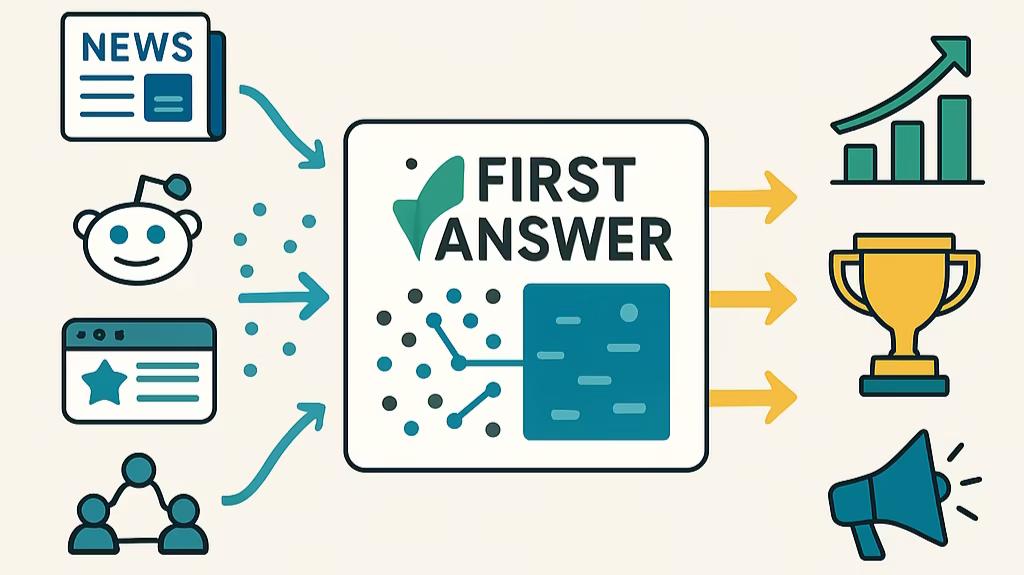
Here is how First Answer acts:
- Continuous Monitoring: We track how your brand is mentioned on platforms like ChatGPT, Gemini, and Copilot, 24 hours a day.
- Competitive Analysis: We show not only how you appear but how your competitors are positioning themselves, revealing your Share of Voice in the AI environment.
- Source Identification: We discover exactly which sources (articles, news, reviews) are influencing what AIs say about your market, allowing you to focus your marketing and PR efforts where it really matters.
- Actionable Insights: We transform raw data into strategic insights, showing opportunities to improve your positioning and strengthen your digital reputation.
With First Answer, you stop guessing and start actively managing your AI visibility, ensuring your brand is the right answer, at the right time.
The Future of AI Brand Visibility: Trends and Predictions
The field of AI optimization is just beginning, but some trends are already clear:
- Hyper-personalization: AI responses will become increasingly personalized based on the user’s history and context. Visibility will need to be earned in multiple contexts.
- Multimodality: Voice and image search will integrate even further into AI responses, requiring brands to optimize not just text, but also images, videos, and audio.
- The “Invisible Web” as a Source: AIs will continue to extract information from an ever-wider range of sources, including APIs, databases, and real-time conversations, making monitoring even more complex and crucial.
Adaptation is no longer a choice. Brands that invest today in understanding and optimizing their AI brand visibility will be building the foundation for tomorrow’s market leadership. The transformation of digital marketing by AI is profound, and being at the forefront of this movement is the only way to ensure continuous relevance and growth.
Frequently asked questions
AI brand visibility refers to a brand’s presence and reputation within responses generated by language models like ChatGPT and Gemini. While traditional SEO focuses on ranking links on a results page, AI optimization (GEO/AEO) focuses on influencing the AI’s knowledge base so that your brand is cited directly as a trusted source in the answer.
AI brand monitoring starts with defining prompts and keywords relevant to your business and then systematically analyzing AI responses. However, the most effective way is to use a specialized platform like First Answer, which automates mention tracking, analyzes sentiment, and compares your performance with competitors at scale.
Answer Engine Optimization (AEO) is the set of practices to optimize your content and data to be easily found and used by “answer engines,” like Google Search with AI. It is crucial because consumer decisions are increasingly influenced by direct answers provided by these platforms, often before even clicking on a website.
It is not a replacement, but an expansion. Traditional SEO remains fundamental for visibility in classic search results and for building the domain authority that AIs themselves use as a source. SEO for language models (GEO and AEO) is an additional and necessary layer to ensure brand relevance in the new era of AI-generated responses.
Want to know if your brand is being mentioned by AI and understand how to appear in responses generated by ChatGPT, Gemini, and Copilot? Meet First Answer — the platform that monitors and boosts your brand’s visibility in artificial intelligence mechanisms.