Rodrigo Beckmann
CEO

The internet has a new front door, and it’s powered by artificial intelligence. A recent McKinsey report reveals a tectonic shift in consumer behavior: half of all consumers now use AI-powered search, a trend projected to channel a staggering $750 billion in revenue by 2028. This isn’t a distant future; it’s the current reality for brands navigating a landscape where generative AI tools like ChatGPT, Perplexity, and Google’s AI Overviews are becoming the primary source for discovery and decision-making. As traditional search traffic faces a potential 20-50% decline, a new metric has emerged as the definitive measure of a brand’s online presence: AI Visibility.
This article explores the rise of AI Visibility as a critical discipline, explaining why it’s supplanting traditional SEO metrics. We will analyze how AI models select and rank brands, delve into the strategies of “Answer Engine Optimization (AEO)” and “Generative Engine Optimization (GEO),” and introduce how pioneering platforms like First Answer are empowering businesses to measure and master their presence in this new AI-driven ecosystem.
What is AI Visibility? AI Visibility is a measurable discipline that tracks how often, in what context, and with what sentiment a brand appears within AI-generated answers from large language models (LLMs) and conversational engines. As search evolves into conversation, AI Visibility becomes the core metric showing how discoverable and credible a brand is to the algorithms that now shape consumer perception and trust.
The Rise of AI Visibility: How Generative AI Redefines Search and Brand Exposure
For decades, the goal of digital marketing was clear: rank number one on Google. But the age of ten blue links is fading. Today, users don’t just search; they ask questions and receive synthesized, conversational answers. This fundamental change, driven by generative AI, has profound implications for brand discovery.
According to a 2025 report from MarTech, nearly 60% of Google searches are now “zero-click,” meaning users get their answers directly on the results page from AI summaries and other features. This shift means the first point of influence is no longer a click to your website but an appearance inside the AI’s answer. This is the essence of AI Visibility.
Industry research from Search Engine Land confirms this new hierarchy with its AI Visibility Index, a study analyzing brand performance across leading AI search engines. The findings reveal a startling disconnect: top Google rankings do not guarantee a mention in AI-generated results. Instead, AI models prioritize brands that demonstrate authority, consistency, and trustworthiness across a wide array of sources, including forums, reviews, and user-generated content.
Beyond SEO: Why AI-Driven Models Demand a New Visibility Metric
Traditional Search Engine Optimization (SEO) focused on optimizing a brand’s owned assets—its website, blog, and landing pages—to rank for specific keywords. AI Visibility requires a broader, more holistic approach. While technical SEO fundamentals remain important, the new discipline of AI Search Optimization recognizes that AI models learn from the entire internet, not just your domain.
Here’s why AI Visibility is the new benchmark:
- AI Models Synthesize, Not Just Rank: Unlike search engines that point users to a list of sources, generative AI consumes information from countless documents and synthesizes a single, authoritative answer. Your brand’s goal is to be a key ingredient in that synthesis.
- Mentions Are the New Backlinks: While high-quality backlinks still matter, AI models place immense value on brand mentions within high-authority sources. A study from Ahrefs found that brands with the most web mentions appear up to 10 times more often in AI results. Being discussed on platforms like Reddit, cited in industry reports, or mentioned by experts has become a powerful signal of relevance.
- Trust is Algorithmically Determined: AI models are designed to identify and surface trustworthy information. They assess signals of expertise and authoritativeness (E-E-A-T) not just on your site, but across the web. Consistency in messaging, positive sentiment, and validation from third-party sources are critical.
This new reality requires a shift in mindset and strategy, moving from a purely technical optimization process to a comprehensive brand presence strategy.

For a deeper dive into how AI is changing the digital marketing landscape, see our analysis on how AI is transforming SEO.
How AI Search Engines Decide What to Show: Source Trust, Context, and LLM Selection
To win at AI Visibility, marketers must understand how large language models (LLMs) decide which brands to feature. It’s not a single algorithm but a complex interplay of factors that weigh source credibility, contextual relevance, and data structure.
Key decision factors include:
- Topical Authority: AI prioritizes sources that demonstrate deep and consistent expertise on a specific subject. A brand that publishes in-depth, original research and is frequently cited by other authoritative domains is more likely to be trusted by the AI.
- Structured Data and Schema: AI models rely on structured data (like Schema.org markup) to understand content. Using formats like FAQPage, Article, and Product schema provides clear signals that help AI parse and cite your information accurately.
- Content Freshness and Originality: Recent, regularly updated content is favored, especially for time-sensitive queries. Furthermore, original research, unique data points, and expert-led insights are far more likely to be cited than summarized or aggregated content.
- User-Generated Content (UGC): The Search Engine Land study highlights that forums, reviews, and authentic user conversations are now key drivers of brand visibility in AI search. Platforms like Reddit and Quora have become critical sources for understanding public sentiment and real-world experience.

Researchers are even developing advanced methods to quantify this new form of online presence, which one arXiv paper describes as a measure of “algorithmically infused visibility.” This academic interest underscores the technical depth behind what appears to be a simple conversational answer.
Measuring Visibility in AI: Tools, Metrics, and the Role of AI Observability Platforms
If you can’t measure it, you can’t improve it. While only 16% of brands systematically track their AI search performance, according to McKinsey, this is rapidly changing. A new category of software is emerging to provide LLM monitoring and AI observability.
Traditional analytics tools are insufficient because they are built to measure traffic, not influence within a closed AI ecosystem. New platforms are needed to answer critical questions:
- How often is my brand mentioned in AI answers for key commercial queries?
- What is the sentiment and context of these mentions?
- Which of my competitors are appearing more frequently?
- What sources are the AI models citing when they recommend a brand?
This is precisely the challenge that First Answer was built to solve. Established in 2025, our platform is designed to help brands understand, track, and improve their presence in AI-generated answers. By monitoring brand mentions, analyzing context, and tracking competitor movements, First Answer provides the actionable insights needed to enhance brand relevance in this new landscape. For more on this topic, explore our list of the top 6 LLM tracking tools for AI visibility.
From GEO to AEO: Strategic Optimization for Answer-Driven Discovery
As the discipline of AI Search Optimization matures, two key methodologies have emerged:
- Generative Engine Optimization (GEO): This is the broad practice of making your brand and content more visible to generative AI systems. GEO focuses on building brand authority, ensuring content is well-structured, and optimizing for the semantic, conversational queries common in AI chats. It’s about ensuring the AI knows you’re a credible player in your field.
- Answer Engine Optimization (AEO): A subset of GEO, AEO is the tactical process of structuring content to provide clear, direct answers to specific questions. This involves using formats like FAQs, “What is…” sections, and concise summaries that an AI can easily extract and present to a user. The goal is not just to be known by the AI, but to be the source of the answer.
A successful AI Visibility strategy integrates both GEO and AEO. GEO builds the foundational brand trust that makes an AI consider you, while AEO provides the perfectly formatted content that makes it easy for the AI to cite you.
First Answer’s Role: Tracking Mentions, Analyzing Sentiment, and Optimizing Visibility
In this evolving digital ecosystem, flying blind is not an option. First Answer serves as the cockpit for brands navigating the complexities of AI Visibility. Our platform addresses the core challenge of modern marketing: brands are becoming invisible in the age of conversational AI.
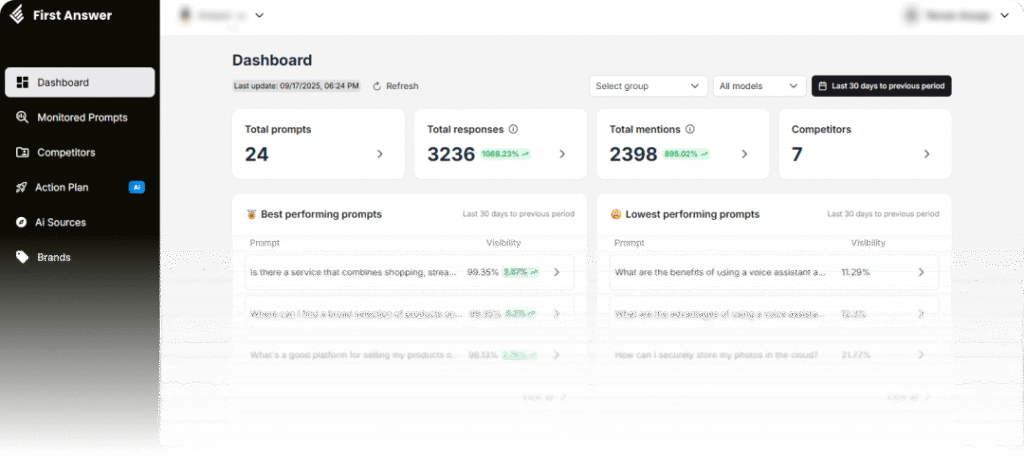
Here’s how First Answer empowers marketing leaders:
- Comprehensive Mention Tracking: We monitor your brand’s presence across all major AI platforms, including ChatGPT, Perplexity, and Bing Copilot, giving you a unified view of your AI Visibility.
- Context and Sentiment Analysis: We don’t just tell you if you were mentioned; we show you how. Our platform analyzes the sentiment and context of each mention, helping you understand how your brand is being portrayed.
- Competitor Benchmarking: See how you stack up against the competition. First Answer tracks competitor movements in AI-generated responses, revealing opportunities and threats in real-time.
- Actionable Insights: Our dashboard translates complex data into clear, actionable recommendations to improve your brand’s relevance and ensure you are recognized as a trusted source in AI-driven searches.
By providing these critical insights, First Answer helps brands move from a reactive to a proactive stance, allowing them to shape buying decisions and value perception in the AI era.
The Future of AI Visibility: What the Next Generation of AI Search Means for Brand Strategy
The current shift to AI-driven search is just the beginning. The next wave will likely involve AI agents that don’t just provide answers but take action on behalf of users—making purchases, booking appointments, and planning itineraries. In this future, AI Visibility will be even more critical, as being the AI’s preferred brand could mean being automatically selected.
Brands that invest in building their AI Visibility today are not just optimizing for the present; they are future-proofing their business. The core principles—building authentic authority, creating high-quality, structured content, and engaging with communities—are timeless. The difference is that the audience is no longer just human; it’s also the AI that serves them.
Curious how your brand performs in AI-generated answers?
Explore First Answer — the platform that tracks, analyzes, and improves your brand visibility across AI search ecosystems.
Frequently asked questions
AI Visibility measures a brand’s presence within AI-generated answers, focusing on mentions, sentiment, and contextual relevance across the entire web. Traditional SEO is more narrowly focused on ranking a brand’s own website in search engine results pages for specific keywords. While related, strong SEO does not guarantee good AI Visibility.
Generative Engine Optimization (GEO) is the practice of optimizing content and brand presence to be discoverable, credible, and favored by generative AI systems like ChatGPT and Google’s AI Overviews. It expands on SEO by prioritizing topical authority, brand mentions, and conversational content structure.
Measuring AI Visibility requires specialized tools that can track how your brand appears across various AI models. You can perform manual checks by asking relevant questions to different AI chatbots, but for systematic tracking, platforms like First Answer are designed to monitor mentions, sentiment, and competitor presence automatically.
AI models use brand mentions across authoritative websites, forums, and publications as a strong signal of trust and relevance. Unlike traditional SEO, where backlinks are paramount, unlinked mentions can significantly contribute to how an AI perceives your brand’s credibility and expertise.
To improve your AI Visibility, focus on building topical authority through high-quality, original content. Structure your content with clear headings and use schema markup. Actively seek brand mentions in reputable third-party publications and engage with communities on platforms like Reddit. Finally, use an AI visibility platform like First Answer to track your progress and identify new opportunities.