Johanna Goulart
CEO

The way people search online is changing, fast. Instead of scrolling through a list of blue links on Google, more and more users are turning to tools like ChatGPT, Perplexity, Bing Copilot, and Google’s Search Generative Experience (SGE) for direct, conversational answers.
These tools don’t show results. They give you the answer. And in this new reality, traditional SEO isn’t enough. The new frontier is GEO – generative engine optimization. And the technical foundation of GEO is called LLMO: large language model optimization.
What is LLMO?
LLMO, or large language model optimization, is the process of structuring and writing content in a way that makes it easy for AI systems — like ChatGPT, Claude, Gemini, and Bing Copilot — to understand, summarize, and cite your content when generating answers.
While SEO focuses on helping your content rank in traditional search engines, LLMO is about helping your content be chosen by the AI itself as a trusted source when someone asks a question.
SEO gets you listed. LLMO gets you mentioned — directly in the answer.
And that matters. Because when users turn to generative AI for information, they’re not seeing a list of ten links. They’re getting one answer. If your brand isn’t in it, it’s invisible.
If you’re new to generative engine optimization, check out our detailed post on what GEO is and why it matters for AI-driven search.
Why LLMO is the technical core of GEO?
GEO – generative engine optimization – is the big picture: it’s about making sure your brand shows up in AI-generated answers.
LLMO is how you actually make that happen.
And today, that matters more than ever.
- Google’s AI Overviews have already caused a major drop in clicks – over 30% fewer users are visiting the top organic results
- More people are turning to AI assistants as their first stop, not search engines
- When someone asks a question, the AI doesn’t list ten links—it gives two or three direct answers, often naming specific brands
If your content isn’t built to be found and cited by these systems, you’re not part of the answer—and not part of the decision.
Test Your Prompts with First Answer. Simulate real AI queries and get cited more often
What makes content optimized for LLMO?
If you want your brand to show up in AI-generated answers, your content needs to be more than just well-written — it needs to be AI-friendly.
That means making it easy for language models to understand, trust, and quote you. Here’s what great LLMO content has in common:
- Clear structure — Use semantic headings (H2, H3), short paragraphs, and logical sections. This helps AI models understand the hierarchy and flow of your ideas.
- Readable and direct — Avoid filler and marketing speak. Be clear, factual, and concise — language models respond better to content that gets straight to the point.
- Citable — Include useful, self-contained insights: definitions, comparisons, stats, examples. These are the building blocks AI uses to construct answers.
- Topically rich — Don’t just touch the surface. Cover the subject in depth, using related terms, subtopics, and real-world context. That gives AI more confidence to trust and reuse your content.
A quick example…
Let’s say you publish a guide called “SaaS pricing models explained.” You break it into sections like “freemium,” “tiered,” and “per-user,” and for each, you provide a short definition and a simple comparison table.
Because it’s well-structured, informative, and easy to pull from, tools like ChatGPT or Claude are far more likely to reference your content when someone asks: “What are common pricing strategies for SaaS tools?”
That’s the power of LLMO. You’re not just publishing content — you’re training the AI to mention you.
LLMO vs. SEO: what’s the difference?
SEO and LLMO aren’t competitors — they’re built for different eras of search.
SEO helps your content rank in traditional search engines like Google. LLMO helps your content get selected and cited inside AI-generated answers.
In short: “SEO gets you clicks. LLMO gets you quoted.”
Here’s how they compare:
| Aspect | SEO (Search Engine Optimization) | LLMO / GEO (Generative Engine Optimization) |
| Primary goal | Appear at the top of search engine results | Be included directly in AI-generated responses |
| Core strategy | Focus on keywords, backlinks, meta tags | Focus on structure, clarity, semantics, and authority |
| User output | Listed as one option among many | Quoted or summarized as the answer |
| Target audience | Human searchers comparing pages | AI models generating direct answers for users |
In practice, the best strategy today is to use SEO and LLMO together. One gets you discovered. The other gets you remembered.
Transform SEO and GEO. First Answer bridges the gap with real-time AI insights.
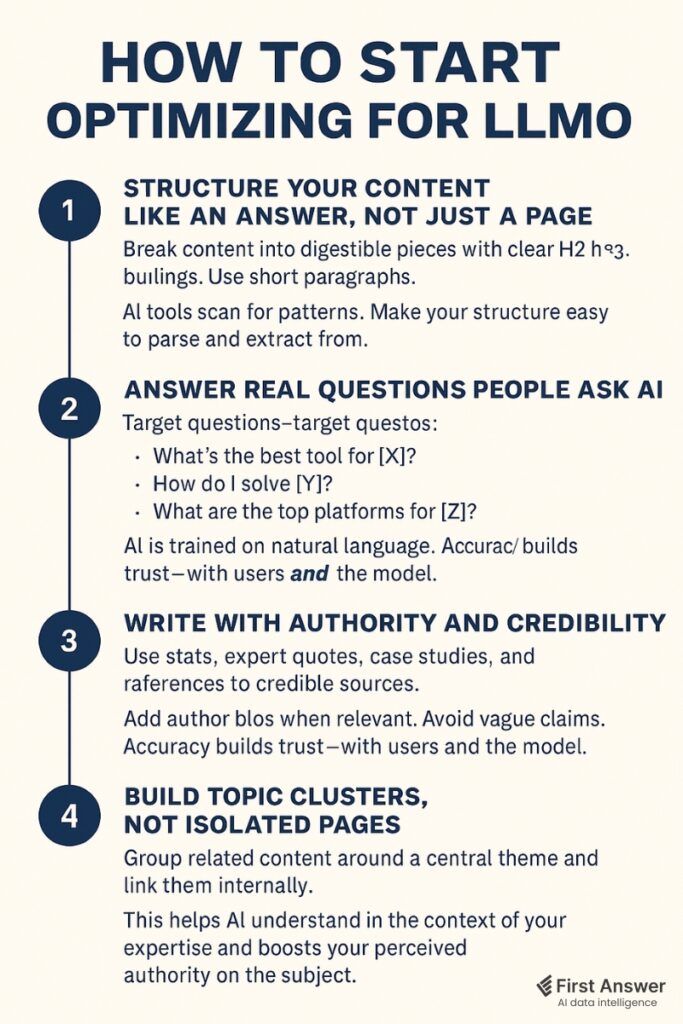
How to start optimizing for LLMO
Getting your content picked up by AI doesn’t require magic, it requires structure, clarity, and credibility. Here’s how to start making your content truly LLMO-ready:
1. Structure your content like an answer, not just a page
Break your content into digestible pieces with clear H2 and H3 headings. Use short paragraphs, bullet points, and visual cues like TL;DR summaries and FAQs.
AI tools scan for patterns. Make your structure easy to parse and extract from.
2. Answer real questions people ask AI
Don’t just target keywords, target questions.
Think:
- “What’s the best tool for [X]?”
- “How do I solve [Y]?”
- “What are the top platforms for [Z]?”
AI is trained on natural language. Your content should match the way real people phrase their queries.
3. Write with authority and credibility
AI models favor trustworthy, fact-based content. Use stats, expert quotes, case studies, and references to credible sources.
Add author bios when relevant. Avoid vague claims. Accuracy builds trust — with users and the model.
4. Build topic clusters, not isolated pages
Group related content around a central theme and link them internally. This helps AI understand the full context of your expertise and boosts your perceived authority on the subject.
5. Expand your presence beyond your website
It’s not just about what’s on your site, it’s about where else your brand shows up.
Contribute to platforms like Reddit, Quora, and Stack Overflow. Pitch guest posts. Get mentioned in credible media and expert roundups.
The more you’re cited externally, the more likely AI is to view you as a trusted source.
Looking for the best GEO tools for content optimization in 2025? Check out our full GEO tools comparison to align with today’s AI-driven search trends.
What to avoid in LLMO?
Not all visibility tactics work, and some can actively hurt your brand. Just like early SEO had its black-hat phase, LLMO is already seeing its share of shortcuts and bad advice.
Here’s what to stay away from:
- Keyword stuffing — Repeating the same terms or synonyms over and over doesn’t help. AI models recognize this as low-quality content.
- Low-effort AI-generated text — Publishing content straight from an AI without editing, fact-checking, or adding original value is a fast way to get ignored — or worse, flagged.
- Hidden or misleading tactics — Tricks like stuffing keywords in invisible text or using white-on-white formatting are outdated and risky. They erode credibility.
- Fake citations or inflated authority — Fabricating data, testimonials, or quotes may seem clever, but AI models (and people) are getting smarter at spotting what’s real.
- “Get listed in ChatGPT” promises — Be cautious of anyone selling hacks to “inject” your brand into generative answers. LLMO is earned, not gamed.
LLMO is about building real trust, with AI and with your audience. There’s no shortcut to clarity, credibility, and relevance.
Boost GEO with First Answer. Try for free
LLMO isn’t optional – it’s the new standard
Your homepage isn’t always the starting point anymore. The answer is.
In a world where users rely on generative AI to guide decisions, your brand needs to be in the response, not just on the internet.
If you’re not showing up in those answers, it doesn’t matter how great your product or service is—you’re invisible when it counts.
That’s where LLMO comes in. And at First Answer, we’re helping brands take control of that visibility. From prompt testing and content audits to real-time AI citation tracking, we give you the insight (and tools) to make sure your brand is seen, trusted, and mentioned — where it matters most.
Dominate LLMO and GEO with First Answer
Want to make your brand the first thing AI mentions? First Answer is your partner in mastering LLMO (Large Language Model Optimization) and GEO (Generative Engine Optimization)—the new standard for visibility in AI-powered search.
We help brands optimize their content so it’s not just ranked—it’s referenced directly inside generative answers from tools like ChatGPT, Google SGE, Bing Copilot, and Perplexity.
With First Answer, you get:
- GEO-ready content audits to assess how well your pages perform in AI-generated responses
- LLMO optimization strategies focused on structure, clarity, and citable authority
- AI visibility tracking tools that monitor when and where your brand is mentioned by language models
- Prompt testing and simulation to ensure your content appears in top AI results for key user questions
GEO is the future of search—and First Answer helps you lead it. Get ahead with content designed to earn citations, build trust with AI, and show up where decisions are made.
Create your account and get started today