Rodrigo Beckmann
CTO

In short
- ChatGPT Wallet, launched on November 13, 2026, lets OpenAI's agents pay for purchases on a user's behalf. For now it is limited to Pro subscribers in the US.
- The purchase happens on the merchant's own site, through the checkout that already exists. The merchant keeps pricing, fulfillment, returns, and customer service.
- Payment is the last step. The step that decides the sale comes earlier: being the brand the agent picks.
- Three things deserve attention now: showing up in AI answers, not blocking the agent by accident, and measuring sales that start in a conversation.
What OpenAI launched
OpenAI announced ChatGPT Wallet on November 13, 2026. It is a digital wallet that lets dots, the company's agents, pay for purchases on a user's behalf. It was built with American Express, Mastercard, and Visa.
According to the announcement, a purchase works like this:
- You add a card to the wallet once.
- When the agent prepares a purchase, you review the items, the total, and the selected card.
- Approval requires a security check, such as Face ID or a fingerprint scan.
- The payment network issues a token with its own card number, security code, and expiration date, which stands in for your real card details.
- The charge goes to the card you selected. Neither the agent nor the merchant sees the real number.
Initial access is limited to ChatGPT Pro subscribers aged 18 and older in the US, with eligible US-issued cards. OpenAI says it wants to learn from real-world use and work with banks, businesses, and payment networks before expanding.
It also helps to be clear about what the Wallet is not:
- It is not available outside the US. The announcement gives no date for other countries or plans.
- It is not automatic buying. Today, every purchase needs your approval. Delegation with spending limits, categories, and time periods is a future plan.
- It is not a checkout inside the chat. The transaction happens on the merchant's site.
The purchase moved back to the brand's site
This is what most separates the Wallet from OpenAI's earlier attempt. In 2025, the company launched Instant Checkout, which completed the purchase inside ChatGPT. The feature was discontinued in March 2026.
Walmart is the most cited case. Daniel Danker, its EVP of product and design, said purchases made inside ChatGPT converted at one third the rate of those where users clicked through to Walmart's site (Search Engine Land).
With the Wallet, the path is reversed. The agent opens a browser, goes to the merchant's site, and uses the existing checkout. The announcement says users transact directly with businesses, which keep their customer relationships and control over pricing, fulfillment, returns, and customer service.
For your store, that has two consequences. First, there is no new payment integration to build: OpenAI's documentation says the Wallet works with existing checkout pages. Second, your site now receives a visitor that is not human, and security systems do not always know what to do with it.
Before paying, the agent chooses
The Wallet solves the last step of a purchase. The step that decides the sale comes earlier: which brands and products the agent puts in front of the user.
OpenAI describes it the same way. According to the announcement, 1.2 billion people use ChatGPT each week, and many turn to it to research products, compare options, and decide what to buy. The Wallet turns that decision into an order.
The order of OpenAI's recommendations for businesses points the same way. The first one is about helping customers find accurate product information. Payment comes later.
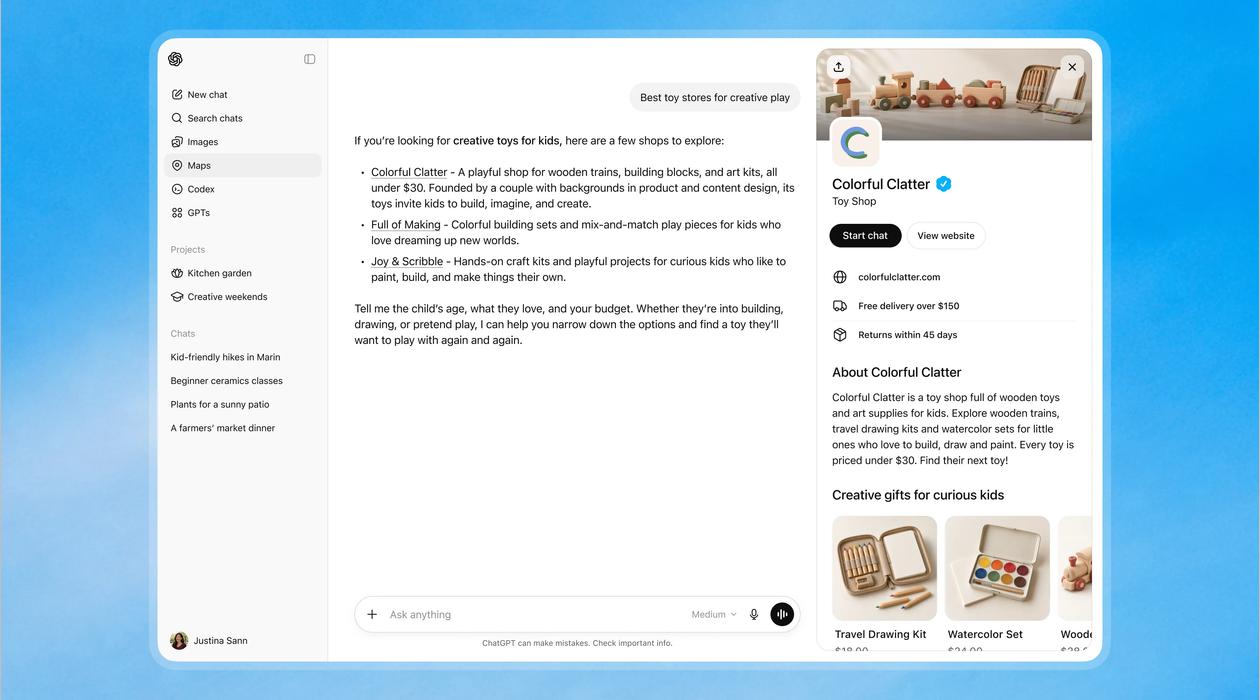
In practice, if your brand does not show up when someone asks for "the best running shoes under $120", there is no cart to approve. Agent payments only benefit brands that were already chosen in the conversation.
That research habit is already measurable. In the 2026 Global Digital Shopping Index from Visa and PYMNTS Intelligence, 48% of online shoppers used AI to research their most recent purchase. The survey covered 5,241 consumers in the US, Brazil, and the UAE in March 2026.
What your brand can do now
None of these four actions depends on the Wallet reaching your market.
1. Find out whether your brand shows up
List the buying questions in your category and see how ChatGPT, Gemini, Perplexity, and other AI models answer them. Note which brands appear, in what order, and which sources are cited. This is the monitoring First Answer runs continuously.
2. Check that your site is not blocking the agent by accident
The agent's browser identifies itself with signed requests, using the Web Bot Auth standard (RFC 9421). According to the documentation, Akamai, Cloudflare, HUMAN, and Vercel already verify these signatures automatically.
The documentation treats these visits as separate from OpenAI's crawlers, such as OAI-SearchBot. Allowing the agent does not change how crawlers are handled. This is a job for whoever manages your CDN or firewall.
3. Keep pricing and availability consistent
The agent reads the page as a customer would. A price or stock mismatch between the ad, the product page, and the cart can stall the purchase.
OpenAI also accepts product feeds through its Business Hub, used for product discovery. Before planning around this, confirm with OpenAI that your market is supported.
4. Talk to your fraud provider and measure the channel
OpenAI acknowledges that risk systems may decline legitimate purchases made by agents. It says it is working with Forter, Riskified, Sardine, and Signifyd, and with Adyen, Checkout.com, and Stripe, to reduce those declines. Ask your provider how it recognizes these transactions.
Measurement is part of the work too. In the same Visa and PYMNTS study, only 23% of the 1,185 merchants surveyed could clearly identify AI-driven traffic and purchases.
The counterpoint: it's still early
OpenAI itself writes that agentic commerce is in its early days. Adoption numbers say the same.
| Data point | Source |
| 76% of shoppers do not want a personal AI agent buying for them | Salesforce, more than 2,500 shoppers in the US, UK, Canada, and Australia |
| 19% of people who use a personal AI agent have used it at checkout | Salesforce, same survey |
| DoorDash has reported only several hundred orders placed by AI agents | TechCrunch |
| 45% of Americans have used or would consider using an AI shopping agent | Global Payments, 8,027 consumers in 7 countries, May 2026 |
Willingness runs ahead of practice. Many shoppers say they are open to the idea, and few have let an agent complete a purchase.
The top concern among Americans in the Global Payments survey is payment security, cited by 50%. That is the problem the Wallet's token is designed to address.
The announcement also leaves questions unanswered:
- When the Wallet will reach other countries and other plans.
- Whether users or merchants will pay fees.
- Who bears the loss when the agent picks the wrong item and the user approves without noticing.
Our read: agent-completed purchases are a medium-term bet. The decision made in a conversation with AI is already happening, and that is where to invest first.
First Answer's free analysis shows how your brand appears in AI answers today.
Sources
- OpenAI: Introducing ChatGPT Wallet, November 13, 2026
- OpenAI, Commerce Partner Playbook: overview, agent access, accept payments, and product feeds
- TechCrunch: ChatGPT's new Wallet lets AI agents shop and check out for you
- Search Engine Land: Walmart says ChatGPT checkout converted worse
- PPC Land: 76% of shoppers don't want AI agents buying for them, Salesforce finds
- Global Payments: Consumers Expect AI to Make 15% of Their Purchases Within Five Years, September 23, 2026
- Visa and PYMNTS Intelligence: 2026 Global Digital Shopping Index, The Agentic Commerce Deep Dive
Frequently asked questions
Only in the US, for ChatGPT Pro subscribers aged 18 and older with eligible US-issued cards. OpenAI has not announced dates for other markets or plans.
The announcement names American Express, Mastercard, and Visa as partners and requires eligible US-issued cards. It does not list the eligible issuers.
No specific payment integration is required. According to OpenAI, the tokens work with existing checkout flows. What may need adjusting is your CDN or firewall configuration, so the agent is not blocked, and your fraud tooling, so legitimate purchases are not declined.
No. The payment network issues a token with its own card number, security code, and expiration date. The charge goes to the selected card without the real details being shared.
Not today. Every purchase requires approval with a security check. OpenAI says that, over time, users will be able to pre-approve purchases within spending limits, categories, and time periods.
No. Instant Checkout completed the purchase inside ChatGPT and was discontinued in March 2026. With the Wallet, the purchase happens on the merchant's site.