Rodrigo Beckmann
CEO
For two decades, the digital marketing equation was relatively simple: produce content, optimize keywords, earn backlinks, and rank among the top ten blue links on Google. The goal was the click. However, the massive introduction of Generative Artificial Intelligence (GenAI) into search engines has disrupted this linear logic.
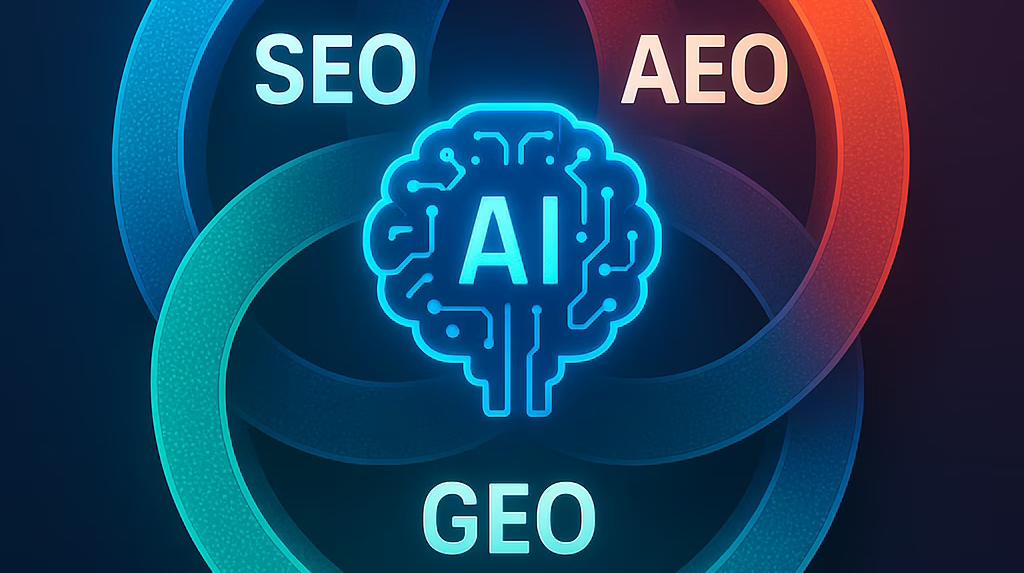
Today, users no longer just want a list of links to investigate; they want a synthesized, reliable, and immediate answer. It is in this scenario that two new disciplines emerge, which, although complementary to SEO (Search Engine Optimization), operate under distinct logics: AEO (Answer Engine Optimization) and GEO (Generative Engine Optimization).
For marketing and digital strategy professionals, understanding the distinction between SEO vs GEO vs AEO is not just a matter of nomenclature, but of competitive survival. While SEO fights for indexing, AEO fights for the single answer, and GEO fights for contextual citation within Large Language Models (LLMs).
In this article, First Answer dissects these three approaches, explaining how your brand can transition from a click-based strategy to a strategy based on generative visibility.
What is SEO (Search Engine Optimization)?
The infrastructure of visibility.
Traditional SEO remains the technical foundation of the internet. It focuses on ensuring that crawlers (tracking robots) can read, index, and rank your pages.
- Focus: Keywords, site architecture, backlinks, and meta tags.
- Goal: Appear on the SERP (Search Engine Results Page) to generate organic traffic via clicks.
- Limitation in the AI Era: SEO ensures that content exists and is accessible, but it does not guarantee that it will be chosen by an AI to compose an answer.
SEO is not dead. It has become the necessary infrastructure layer for AEO and GEO to work. Without indexing (SEO), there is no data for the AI to read.
What is AEO (Answer Engine Optimization)?
The quest for the single answer and the AI Overview phenomenon.
Originally, AEO emerged with the popularization of voice assistants (Siri, Alexa) and Featured Snippets (position zero). The goal was to deliver the exact answer to a specific question without requiring a click.
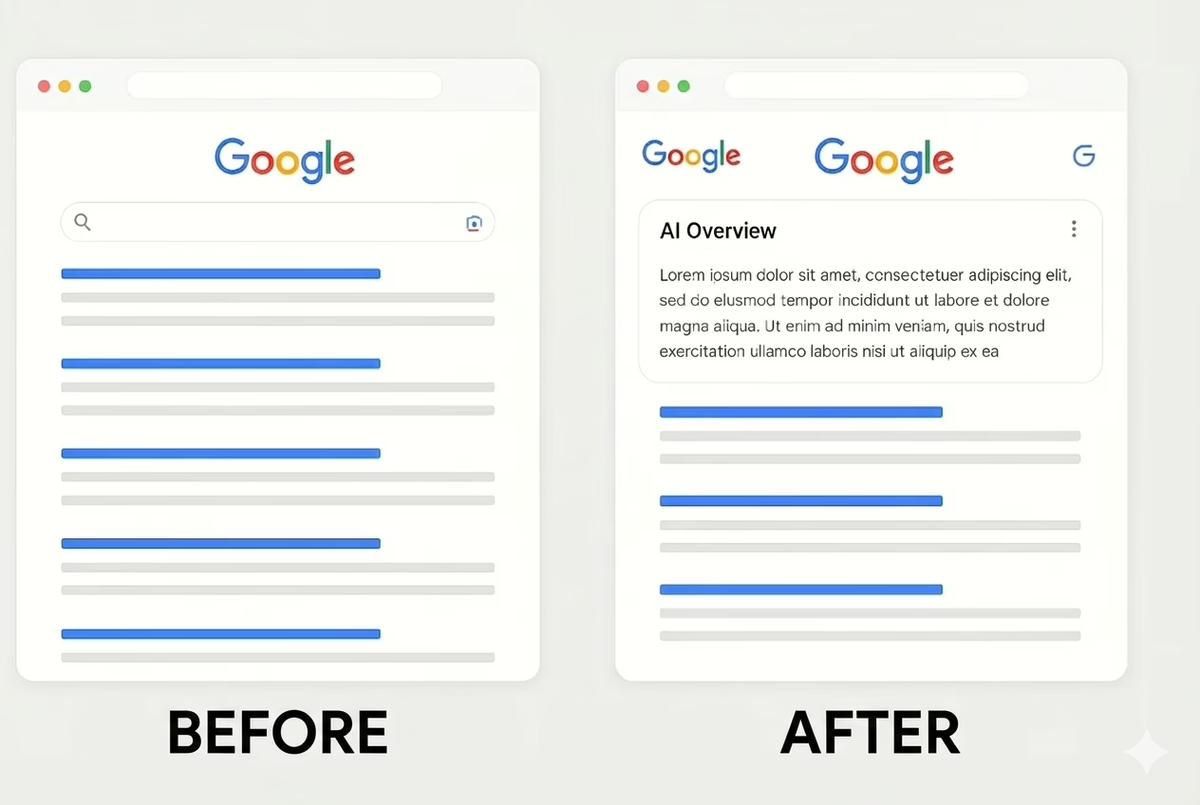
However, with the arrival of Google AI Overview, the concept of AEO has leveled up. Google has moved from being just a search engine to becoming the world’s largest answer engine.
- Focus: Structured data (Schema Markup), factual authority, and conciseness.
- Target Engine: Google AI Overview, Voice Assistants, and Snippets.
- The Evolution: Previously, AEO competed for a snippet of code from your site. Now, in AI Overview, AEO competes for the inclusion of your brand within a synthesized answer by Gemini. If your brand is not cited in the AI answer at the top of the page, it is pushed down, where the click-through rate (CTR) drops drastically.
Google AI Overview is the practical application of AEO. To appear there, you need GEO strategies (for the AI to understand your content) with the goal of AEO (being the displayed answer).
What is GEO (Generative Engine Optimization)?
The new frontier of influence in AI.
GEO is the most recent and complex evolution. It deals with optimization for Generative Engines (such as ChatGPT, Gemini, Claude, Perplexity, and Bing Copilot). Unlike AEO, which seeks an exact datum, GEO focuses on how the brand is understood, cited, and recommended within an AI-synthesized response.
- Focus: Context, entity correlation, brand mentions, sentiment, and presence in sources that feed LLMs.
- Target Engine: Large Language Models (LLMs) and RAG (Retrieval-Augmented Generation) systems.
- The Big Change: In GEO, AI doesn’t just “cut and paste” a snippet (like in AEO); it reads, interprets, and rewrites the information. The goal is to get the AI to cite your brand as the authority on the subject during this rewriting.
The impact of this optimization is measurable. Seminal research conducted by scientists from Princeton and IIT Delhi demonstrated that applying GEO techniques—such as including citations, statistics, and semantic authority—can increase a brand’s visibility by up to 40% in AI responses. The most impressive datum is that sites with lower rankings in traditional SEO managed to outperform market leaders within the AI response, simply by being better optimized for the generative model.
While SEO competes for clicks and AEO competes to be the single answer, GEO competes to be the context and reference that the AI uses to build knowledge.
Where does Google AI Overview fit in: AEO or GEO?
Google AI Overview is the perfect example of the convergence between these disciplines. It creates a “gray zone” that demands a new stance from brands:
- It is an AEO problem: Because Google’s goal is to satisfy the user right there on the results page, eliminating the need to navigate (Zero-Click). Google acts as an Answer Engine.
- The solution requires GEO: Since AI Overview is generated by language models (Gemini family), traditional SEO techniques (keywords and backlinks) lose strength to GEO metrics (context, entity co-occurrence, and semantic clarity).
Google AI Overview transformed the world’s largest search engine into an Answer Engine. Now, AEO is no longer an option for voice assistants; it is the rule for Google’s first page.
Comparison Table: SEO vs GEO vs AEO
To visualize how these strategies coexist and diverge, we have prepared a technical comparative analysis:
| Feature | SEO (Traditional) | AEO (Answer Engine) | GEO (Generative Engine) |
| Main Focus | Ranking pages in the search list. | Being the answer in Google AI Overview or Position Zero. | Being cited and recommended in chats (ChatGPT/Gemini). |
| Target Engine | Google Search (Blue Links). | Google AI Overview, Alexa, Siri. | LLMs (GPT-4, Claude), Perplexity, Copilot. |
| Delivery Form | List of links for choice. | Generated synthesis (Snapshot) or voice response. | Conversational and deep response. |
| Final Goal | Traffic (Click). | Immediate satisfaction (Zero-Click) + Branding. | Influence on decision and recommendation. |
Why is SEO not enough in the AI era?
The massive introduction of Google AI Overview in search results has disrupted the linear logic of organic traffic. When Google occupies the top half of the screen with an AI-generated answer, it pushes traditional organic results out of the user’s immediate view.
Market studies suggest that the presence of AI Overview can reduce traditional organic traffic by 18% to 60%, depending on the sector. This happens because the platform retains the user in the response interface.
The new search funnel:
- The user asks the question.
- AEO (via AI Overview) delivers the synthesized answer.
- The user only clicks if they need complex deepening or a transaction.
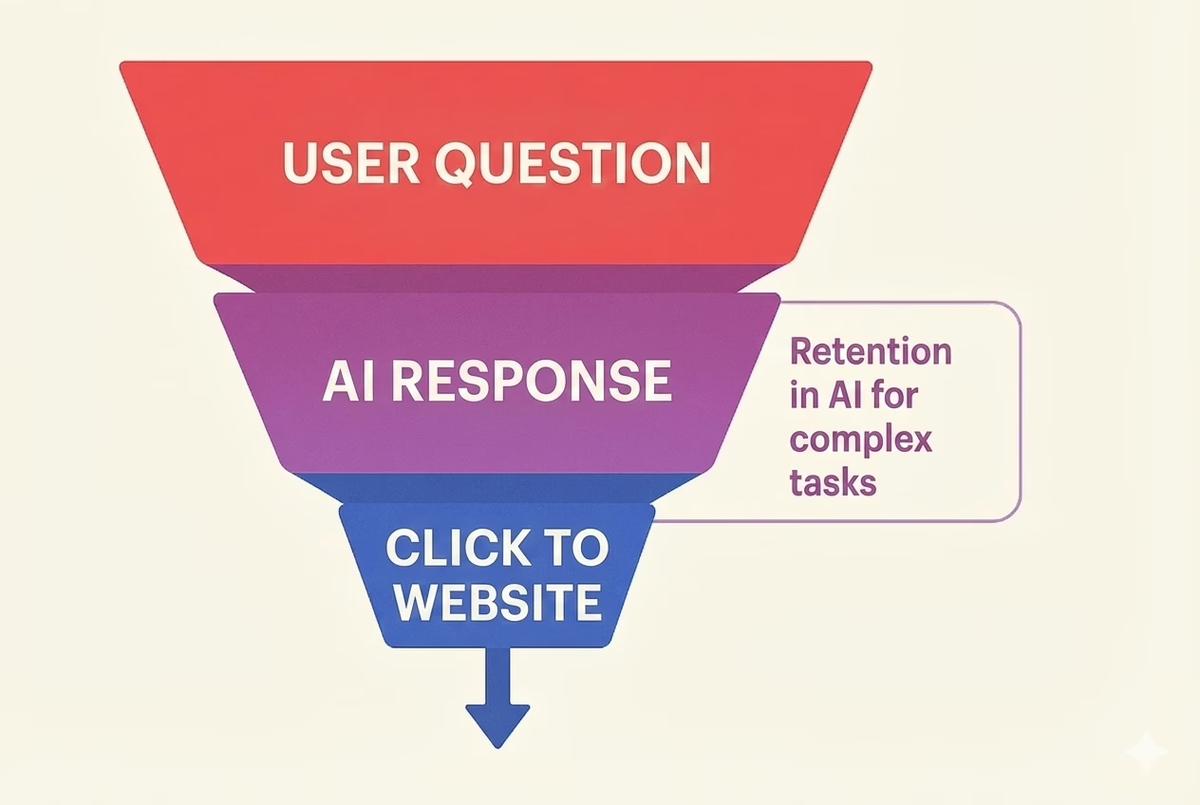
This behavioral shift is backed by academic data. A recent comparative study on information retrieval preferences (Caramancion, 2024) revealed a critical divide: while Google still dominates the search for quick facts (like the weather), users already prefer generative AIs for complex tasks, learning, and interpretation.
In other words: if your brand sells consultative or complex solutions, your potential client may no longer be clicking on Google links—they are satisfied with the AI’s explanation.
If your strategy focuses only on traditional SEO, you are optimizing for an area of the page that is becoming increasingly less visible. It is necessary to optimize for answer generation.
The user no longer wants a list of links. With the growth in the use of ChatGPT as a search tool, the linear research journey has been broken.
Where First Answer comes in: Intelligence for the New Ecosystem
In this new paradigm, brands are largely “flying blind.” They know they are being discussed or omitted in AI responses, but they don’t know how, where, or why.
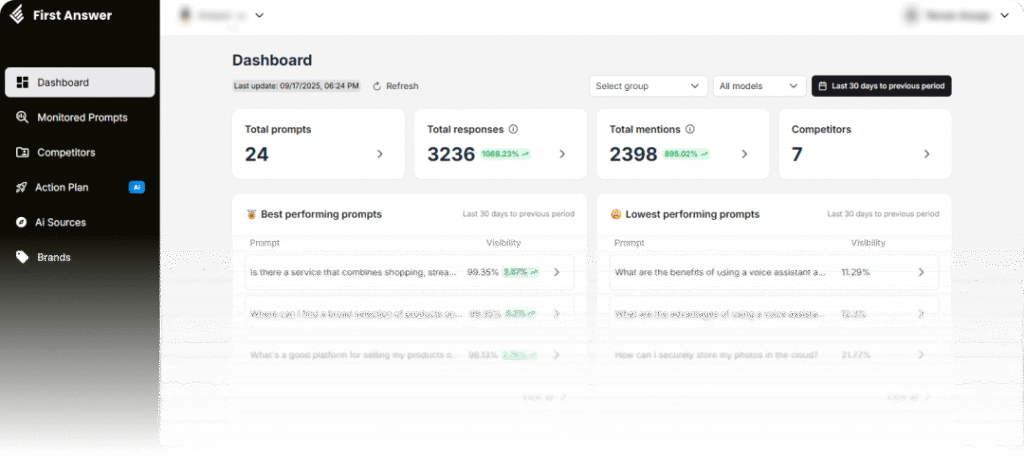
First Answer positions itself as the definitive solution to fill this data gap. As an intelligence platform for GEO and AEO, First Answer enables:
- AI Visibility Tracking: Monitor how your brand appears in responses from models like GPT-4, Gemini, and Claude for strategic keywords.
- Sentiment and Citation Analysis: Understand if the AI is recommending your brand or citing competitors.
- Source Reverse Engineering: Identify which sources (blogs, news, reviews) AI models are using to build their responses, allowing for a Digital PR and Link Building strategy focused on GEO.
GEO and AEO are the natural evolution of SEO—but each solves a different problem. First Answer is the compass to navigate where Google Analytics does not reach.
To dive deeper into how our technology works, we recommend reading about the differences between GEO and AEO in API vs AI Interface.
The Future of Search: Convergence
We are not heading towards the end of SEO, but towards a convergence.
- SEO will ensure your data is accessible.
- AEO will ensure your data is structured for quick facts.
- GEO will ensure your brand has authority and context to be recommended in complex decisions.
Brands that ignore GEO and AEO risk becoming invisible on the “first page” of the future: the chat response.
Next Steps for your Strategy
- Entity Audit: Check how your brand is perceived by current LLMs.
- Content Optimization: Shift focus from keywords to topics. If you want a practical implementation guide, check out our full article on SEO for AI and how to prepare your content.
- Continuous Monitoring: Use platforms like First Answer to track the volatility of generative responses.
Conclusion
The battle for digital visibility has changed fields. The click still matters, but the answer is the new most valuable asset. Understanding the nuances between AEO, GEO, and SEO is the first step to ensuring that when the customer asks the AI, your brand is the first answer.
Want to understand how your brand appears in the main AI models? Meet First Answer — the platform created to measure, compare, and optimize your visibility in answer engines and generative engines. Don’t leave your brand out of the conversation.