Rodrigo Beckmann
CEO
The rise of generative search has transformed how people access information. As platforms like ChatGPT, Gemini, Perplexity, and Copilot become primary discovery channels, users are moving away from traditional blue-link SERPs toward immediate, conversational answers. In this context, SEO is no longer just about rankings — it is evolving into GEO (Generative Engine Optimization) and AEO (Answer Engine Optimization).
In this scenario, traditional SEO tools are becoming insufficient. Consequently, platforms dedicated to AI Visibility are emerging. The current debate in the marketing technology market is: Profound vs First Answer. Which one offers the data necessary for teams to make strategic decisions?
In this article, we analyze the value propositions, features, and technical differentiators of both to help you decide.
The Context of the AI Visibility Market
Before diving into the Profound vs First Answer comparison, it is crucial to understand the problem they solve. With the rise of GEO (Generative Engine Optimization) and AEO (Answer Engine Optimization), brands have lost direct visibility of traffic.
It is no longer enough to know the search volume of a keyword; you need to understand the intent and how AI interprets your brand. AI Visibility tools were born to answer questions like:
- “Is my brand cited when people ask about the best CRM software?”
- “What is the sentiment of the AI when describing my product?”
- “Which competitors does the AI suggest instead of me?”
Overview: First Answer
First Answer positions itself as a brand intelligence platform for the AI era. Its focus is not just on monitoring if the brand appears (“share of voice”), but how it appears.
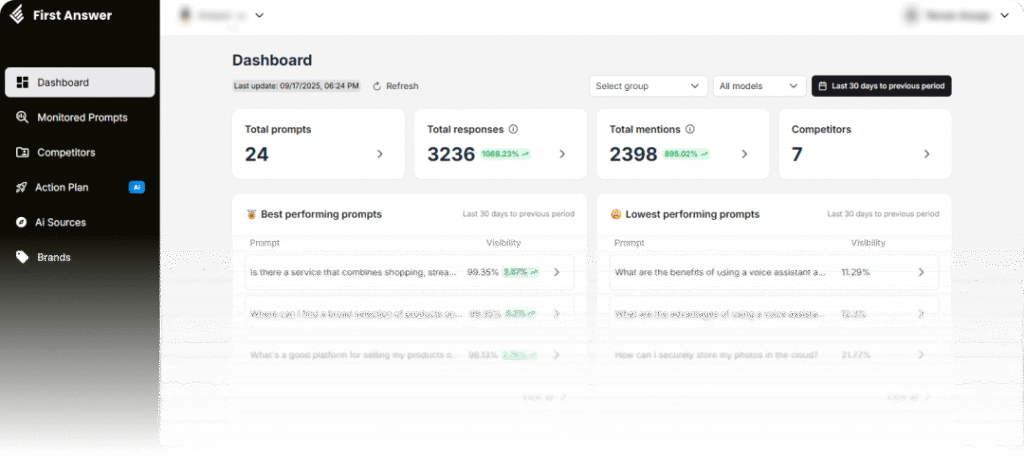
The tool stands out for its analytical depth. It dissects LLM responses to offer insights on:
- Sentiment and Perception: How the AI describes brand attributes (e.g., “expensive,” “innovative,” “slow”).
- Competitive Analysis: Which competitors are cited alongside your company and why.
For teams looking to not only monitor but act with AI visibility strategies, First Answer offers an actionable diagnosis. It transforms AI responses into actionable intelligence for marketing, branding, and product teams, going far beyond simple mention monitoring.
Overview: Profound
Profound is a relevant competitor in the international landscape, focused on helping companies track their visibility in organic AI search. Profound’s proposition is solid in offering presence metrics across various generative search platforms.
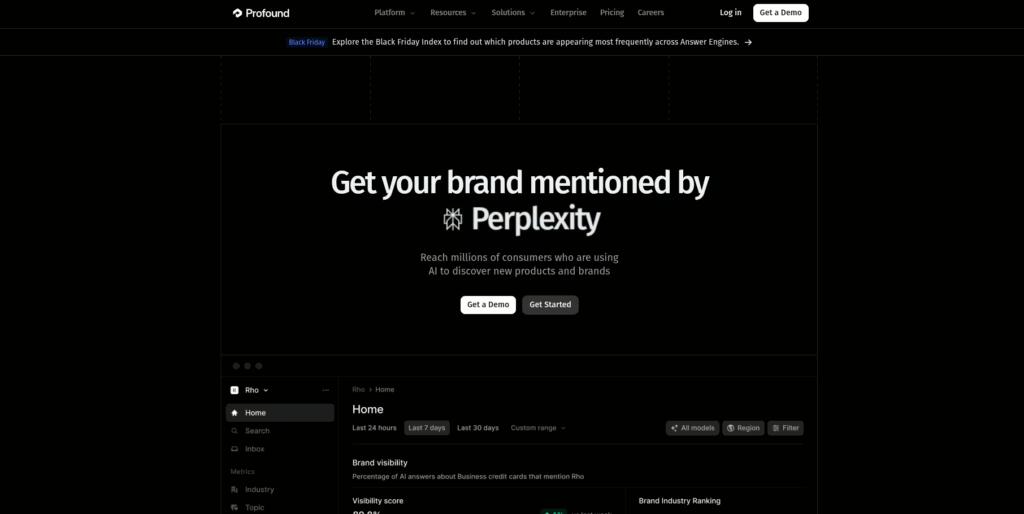
The tool is known for its ability to track trends over time, allowing brands to see if their “market share” in AI responses is growing or shrinking. Profound’s focus tends to be more quantitative, prioritizing presence and ranking within generated responses.
Comparison Table: Profound vs First Answer
To make it easier to visualize the differences in this Profound vs First Answer dispute, we have prepared a table focused on essential criteria for marketing and SEO managers.
| Criterion | First Answer | Profound |
| Main Focus | Brand Intelligence, Context, and Sentiment | Visibility Monitoring and Share of Voice |
| Sentiment Analysis | Detailed (positive, negative, brand attributes) | Greater focus on presence/absence |
| Hallucination Diagnosis | Identifies incorrect/invented information | Standard monitoring |
| Competitor Comparison | Cross-analysis of attributes and positioning | Visibility volume comparison |
| Strategic Action (GEO) | Insights for content optimization and PR | Performance tracking |
| Interface | Analytical dashboard focused on qualitative insights | Dashboard focused on performance metrics |
Value Analysis and Strategic Differences
The choice in the Profound vs First Answer dispute depends largely on the maturity of your AI strategy.
Depth vs. Coverage
If your goal is to have a quick number on “how many responses I appear in,” Profound delivers this metric efficiently. However, if you need to understand why ChatGPT recommends your competitor and not you, First Answer offers the necessary layer of intelligence.
Optimization (GEO/AEO)
For professionals who wish to apply Generative Engine Optimization techniques, it is not enough to know that the brand did not appear. You need to know which sources the AI used to construct the response. First Answer focuses on revealing these connections, allowing for more assertive Digital PR and content work.
Reputation Management
A critical differentiator of First Answer is the ability to qualify visibility through sentiment analysis. It is not enough to know that the brand was cited; it is vital to understand if the mention is favorable or harmful. First Answer allows you to quickly identify if your brand is being mentioned positively or negatively, providing the intelligence needed to protect corporate reputation and adjust strategies—something essential for monitoring LLMs effectively.
Recommended Use Scenarios
To illustrate practical application, let’s consider two strategic examples:
- Scenario A (Focus on Branding): A VP of Marketing wants to know if the brand repositioning is generating a positive perception in AI models.
- Best Choice: First Answer. It will analyze the sentiment of the responses to confirm if the association is beneficial or if criticisms are being propagated.
- Scenario B (Share Monitoring): An agency needs to report monthly if the client’s visibility increased by 5% on Perplexity.
- Best Choice: Both serve the purpose, but Profound may be sufficient if the qualitative context of the response is not relevant to the report.
Conclusion
Both First Answer and Profound are pioneer tools in a market that is just beginning. Profound does an excellent job of quantifying presence in generative searches.
However, when analyzing Profound vs First Answer through the lens of brands that view AI not just as a media channel but as a reputation ecosystem, First Answer stands out. Its ability to transform raw LLM data into strategic insights about brand sentiment and perception offers a superior competitive advantage.
Want to discover how your brand appears in the responses of major AIs? Meet First Answer.